

With the growing demand for mobile MRI machines, there is increasing pressure to complete scans quickly and efficiently while maintaining consistent image quality. Long scan times can reduce patient comfort, and with the rising number of MRI exams, healthcare providers need solutions that allow them to accommodate more patients each day without compromising care.
Siemens Deep Resolve AI addresses these challenges by significantly reducing scan times while delivering exceptional image quality. For mobile imaging environments in particular, this technology ensures reliable performance without adding complexity to existing workflows.
At Platinum Mobile Imaging, we offer a game-changing technology to our customers as a new software package on our New Aera mobile build.
What Is Siemens Deep Resolve AI?
Siemens Deep Resolve AI leverages advanced artificial intelligence, specifically convolutional neural networks, to accelerate MR scans beyond previous capabilities. This AI-powered image reconstruction technology speeds up the scanning process and delivers sharper, more precise images. Integrating Deep Resolve Sharp and Deep Resolve Gain technologies allows for enhanced image clarity, making it possible to achieve high-resolution images from low-resolution input, all while maintaining the integrity of the raw data collected during the scan.
Deep Resolve Siemens AI uses advanced deep learning algorithms to analyze and enhance MR imaging. With optimized neural networks, it excels in denoising, resolution enhancement, and artifact reduction, delivering high-quality images in real-time. By adapting to varying conditions and reducing repeat scans, it improves efficiency, streamlines workflows, and elevates imaging quality.
Advantages of Deep Resolve Imaging
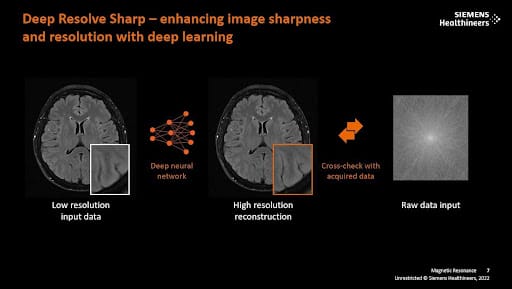
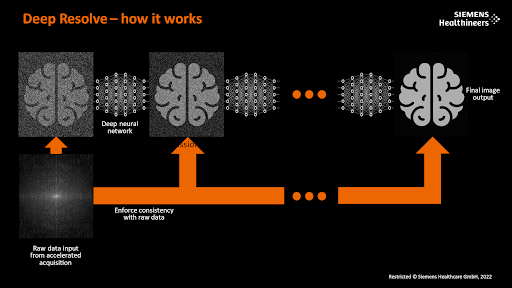 The significant advantage of Siemens Deep Resolve AI is its ability to reduce MRI scan times drastically. For instance, Deep Resolve Boost can shorten scan durations to unprecedented levels, such as enabling a complete knee exam in just two minutes without compromising image resolution. This improves the patient’s experience by reducing the time spent in the scanner and allows healthcare facilities to increase throughput, serving more patients within the same timeframe.
Dr. Saif Afat, MD from University Clinic Tubingen, Germany, confirmed to Siemens: “It really is quite striking to see the impact of Deep Resolve on clinical MR imaging in so many different areas. Let us take prostate imaging as an example: We are going from 10:21 minutes for the T2 TSE in all three orientations with conventional reconstruction to just 03:50 minutes with Deep Resolve. And the image quality is the same or even superior. To me, that is the new upcoming indispensable technology for my clinical routine.”
The technology’s deep learning reconstruction techniques ensure that the denoising strength can be adjusted, offering flexibility to cater to specific clinical needs. The compatibility of Boost with other Siemens technologies, like Deep Resolve Sharp and SMS TSE, highlights its versatility and the potential to set new standards in MRI imaging.
Deep resolve imaging can:
- Accelerate scan time for brain MRI by up to 70 percent.
- Be used in nearly any region of the body.
- Be used in almost every diagnostic MRI procedure.
- Shorten scan times and allow for more patients to be seen.
Key Features
Deep Resolve AI revolutionizes medical imaging with advanced neural networks trained on high-quality MRI datasets. Some key features are:
- AI-Powered Image Reconstruction
- Uses deep learning for accurate, high-quality imaging with reduced scan times.
- Advanced denoising ensures reliable diagnostics.
- Seamless Workflow Integration
- Fully compatible with Siemens Healthineers’ MRI systems for easy integration.
- Minimal operator input for consistent results.
- Clinical Versatility
- Supports T1, T2, DWI, and more, adapting to various diagnostic needs.
- Accelerates imaging with SMS protocols for higher efficiency.
- Scalability
- Real-time processing handles high volumes efficiently.
- Flexible for both routine and specialized imaging.
The technology of Deep Resolve AI
At the core of improving image quality is the Siemens Deep Resolve Sharp technology, which utilizes a deep neural network trained on extensive datasets of high and low-resolution MR images. This allows it to reconstruct high-resolution images from lesser-quality inputs. The benefits are manifold: increased image sharpness, faster image acquisition without sacrificing quality, and the ability to depict small structures more clearly than ever. It combines the power of supervised learning with in-depth knowledge of MRI physics to deliver exceptional performance and reliability.
“We enable our customers to use their scanners in ways we have not seen before,” Arthur Kaindl, Head of Magnetic Resonance at Siemens Healthineers, reveals. “Knee imaging in MRI usually takes about ten minutes on a 3 Tesla system. Using Deep Resolve algorithms, we got that time down to under two minutes—with the same image quality and diagnostic value.”
By significantly reducing MRI scan times while improving image quality, it addresses the most pressing challenges in diagnostic imaging today: efficiency and accessibility. By combining iterative reconstruction with AI-powered denoising techniques, superior resolution is achieved even with limited raw data. This approach enhances the signal-to-noise ratio (SNR) while eliminating the need for extra acquisition time. Faster scans mean less waiting time for patients and more efficient use of MRI machines, translating to cost savings for healthcare providers and improved diagnostic capabilities. Here are the four main areas of Deep Resolve Technology:
Deep Resolve Boost
Siemens Deep Resolve Boost is a state-of-the-art reconstruction technology that employs deep learning and transforms raw data into high-quality images with impressive efficiency. It preserves large signal-to-noise ratios (SNR) for exceptional clarity and precision.
Compatible across the body, it integrates with the Simultaneous Multi-Slice (SMS) technique to enhance imaging speed. Deep Resolve Boost from Siemens reduces scan times while maintaining superior resolution and quality, offering unmatched efficiency in medical imaging.
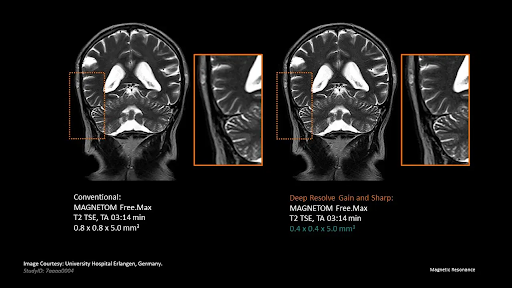
Deep Resolve Gain
Deep Resolve Gain is an advanced image reconstruction technology that intelligently reduces noise. Using individual noise maps, it precisely addresses local noise variations, significantly improving the signal-to-noise ratio (SNR). Fully compatible with TSE sequences, it offers reliability and versatility in clinical applications.
Key Advantages
- Manage local noise variations from coil geometries and acceleration techniques.
- Deliver clinically reliable results with improved SNR.
- Enable faster image acquisition without sacrificing quality.
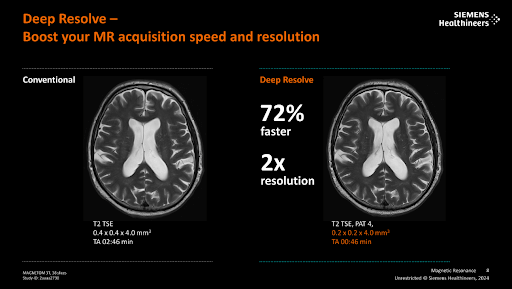
Deep Resolve Sharp
Deep Resolve Sharp is an advanced image reconstruction technology that enhances sharpness with exceptional precision. Using a neural network that is trained on paired low- and high-resolution images, it transforms input that may be of lower quality into high-resolution output.
It is different from traditional methods for interpolation that fill k-space gaps with zeros. This technology predicts and reconstructs data from distant k-space regions for superior clarity. Crucially, the original raw data stays integral to ensure accuracy and reliability in the final output.
Deep Resolve Swift Brain
Currently only offered on 3T MRIs, Deep Resolve Swift Brain is an advanced brain imaging protocol combining Echo Planar Imaging (EPI) with Deep Learning Reconstruction for exceptional speed and precision. It provides five key contrasts: T1, T2, T2, T2 dark-fluid, and diffusion. T1 uses a fast GRE sequence, while the others rely on multi-shot EPI, enhanced by static field correction, to reduce geometric distortions.
Siemens Healthineers’ EPI implementation allows simultaneous T2 and T2 acquisition, optimizing efficiency. The T2 dark-fluid contrast offers faster imaging times with authentic FLAIR contrast.
The Clinical Benefits of Siemens Deep Resolve AI in MRI
Siemens Deep Resolve AI enhances clinical MRI performance by overcoming the traditional tradeoff between scan time and image quality.
In conventional MRI workflows, longer scan times often limit the number of patients that can be accommodated each day and can produce images that lack sharpness in certain sequences. Siemens Deep Resolve AI leverages deep learning during image reconstruction, enabling faster scans without compromising the clarity needed for accurate clinical interpretation.
This technology also improves patient experience. Many patients struggle to remain still during lengthy exams due to discomfort or anxiety, including claustrophobia. By reducing time in the scanner, Siemens Deep Resolve AI minimizes motion artifacts that could obscure anatomical details and require repeat imaging. The result is more reliable scheduling, higher exam completion rates, and smoother workflows especially in high-volume settings.
The benefits are particularly significant in neuroimaging, where even subtle movements can obscure critical structures. In musculoskeletal MRI, consistent image resolution helps clinicians evaluate small joints, cartilage, and soft tissues with confidence. Siemens Deep Resolve AI supports high-quality imaging across complex studies without lengthening appointments or increasing patient stress, ensuring both clinical and operational efficiency.
How Siemens Deep Resolve AI Works
The Siemens MRI Deep Resolve uses deep learning-based image reconstruction that uses data directly from MRI data. Instead of other software, Siemens Deep Resolve doesn’t just apply post–processing filters after image rotation, it actually helps create the image itself during processing. The approach helps with noise reduction and enhanced resolution while also preserving the contrast that is captured during acquisition.
A key component of this process is the Siemens Deep Resolve Boost. This enables higher acceleration factors by managing noise more effectively during image formation. By doing so, Siemens Deep Resolve Boost supports shorter scan times while maintaining image sharpness and clarity. The constructed image stays true to the original raw data, helping maintain diagnostic consistency that also allows for manual review if needed.
Because Siemens AI MRI imaging construction is software-based, it fits within established Siemens MRI workflows without requiring any extensive operator input. The result is a smooth imaging process that supports faster exams while keeping images in line with what radiologists and technologists expect.
Book Your Mobile MRI Unit Through Platinum Mobile Imaging Today
Are you ready to experience the transformative power of Siemens MRI Deep Resolve AI? Contact Platinum Mobile Imaging today to book your Mobile MRI unit and unlock a new level of imaging excellence. Our team of experts provides top-notch service and customer support, ensuring you have everything you need to deliver exceptional patient care. Here’s what to expect.
Don’t miss out on this opportunity to revolutionize your medical imaging capabilities. Lease your Mobile MRI with Platinum Mobile Imaging today!
FAQs about Siemens Deep Resolve AI in MRI
What are the main benefits of Siemens Deep Resolve AI in MRI?
MRI exams can run faster without requiring image quality tradeoffs that often lead to repeat scans. This helps imaging teams complete studies more reliably, especially in patients who struggle with long exam times.
How does Siemens Deep Resolve AI reduce scan times?
Siemens Deep Resolve Boost accelerates MRI exams by using advanced AI to manage noise that typically appears during faster scanning. This reduces overall exam time while maintaining the high image quality clinicians need for accurate interpretation.
This approach benefits a wide range of MRI scans, including:
- Neuroimaging – brain and spine scans, including high-resolution structural imaging
- Musculoskeletal MRI – joints, cartilage, and soft tissue evaluations
- Abdominal and pelvic imaging – liver, kidneys, and reproductive organs
- Cardiac MRI – heart structure and function assessments
- Whole-body and oncology studies – for efficient, high-quality imaging of multiple regions
By cutting scan times without compromising clarity, Siemens Deep Resolve AI improves patient comfort, reduces motion artifacts, and supports smoother scheduling in high-volume imaging environments.
Can I integrate Siemens Deep Resolve AI into my existing Siemens MRI system?
Yes, in many cases, Siemens Deep Resolve AI can be integrated into existing Siemens MRI systems, but it depends on the specific MRI model and software version you currently have. Here’s a clear breakdown:
Siemens Deep Resolve Compatibility
- Siemens Deep Resolve AI is designed to work with a range of Magnetom MRI systems, including both 1.5T and 3T scanners.
- The existing system must meet certain software and hardware requirements; older systems may require upgrades to the latest platform version.
- Integration typically involves installing reconstruction software on the MRI console.